
I didn’t realize it at the time, but my school trained me for how I work today, especially with AI. My school in India was unusual, even by local standards. It was a half-day schedule with eight periods packed into four hours, with just one 15-minute break in the middle. We stayed in the same classroom the entire time while teachers rotated in and out. There was no transition time, no reset, and no real wrap-up between subjects.
Over time, that does something to you. You get very good at dropping context and picking up a new one instantly. Your brain stops expecting that you need time to “get into” something. I call this LADD, learned ADD. Not in a clinical sense, just trained behavior.
Nobody ever told us that context switching was wrong or bad. That was just how school worked, so it felt normal. A few months ago, I did a podcast with Byron Sommardahl about how teams can take advantage of differences in team member task switch costs to speed up software development. However, now in the world of AI, the ability to context switch faster becomes more important.
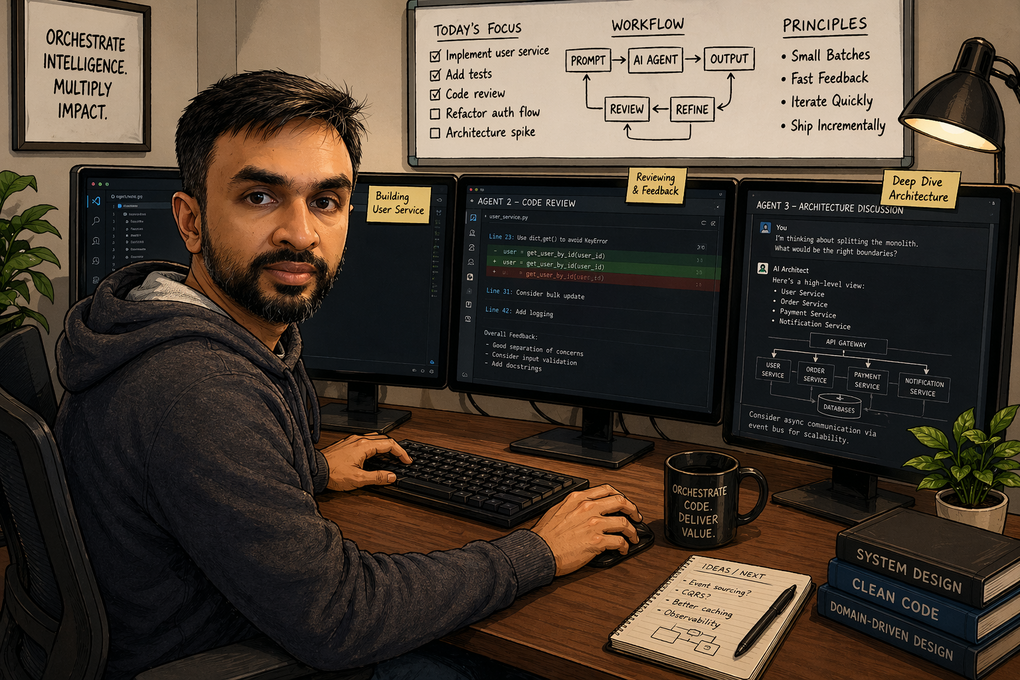
In my day-to-day work, I’ll usually have a couple of AI agents generating code, one doing reviews, and another I’m chatting with about deeper architectural decisions. None of these are instantaneous, so instead of waiting on one, I rotate. I write a prompt, get it started, move to the next thread, then the next, and later come back to review outputs, refine prompts, and push things forward.
I’m essentially time-division multiplexing my attention fast enough that it feels like I’m working on multiple problems at once. It’s not linear development anymore. It’s orchestration. And that rotation feels natural in a way my brain has been trained decades ago.
LADD didn’t teach me how to focus or not focus for long stretches. It taught me how to switch without friction. In a world where AI lets you run multiple threads of work at the same time, that turns out to be a very powerful skill.
Stay tuned for my next posts for tips and tricks on training your brain to context switch faster.