
In my last post, I talked about my school schedule and LADD (Learned ADD). My son’s school teaches a more structured version of the same idea.
His schedule looks very different from what I grew up with. It’s a full day, split into four longer blocks. There are short 10-minute breaks between classes and a longer 20-minute break in the middle of the day. Instead of repeating the same schedule every day, they alternate between A days and B days, so subjects are spread out across two days.
On the surface, it feels like the opposite system. But underneath, there are some interesting similarities.
First, it’s still the same number of subjects, just distributed differently. Second, instead of seeing a subject every day, there’s often a 48-hour gap before you come back to it.
That raises an interesting question. Is it better to engage with something daily in short bursts, or to space it out and come back to it after a gap?
The American system implicitly chooses spacing. You go deeper in a single block, then you leave it completely and return later. That gap forces a reset. You have to reconstruct context when you come back.
Over time, that trains something specific. I think of this as LSAS, Learned Short Attention Span. Not the inability to focus, but the ability to focus in bounded intervals and then switch. The 10-minute breaks help in some ways like physically moving to a different classroom gives you a natural reset. But you get used to reloading context after a delay and you get comfortable with the idea that switching contexts takes time.
Then you step into the working world, where the expectation suddenly becomes very different. Focus deeply. Avoid context switching. Do one thing at a time. Even in this more “balanced” school system, we were never really trained to work that way. What we were trained to do is switch, just with more structure.
Before getting into multitasking, it’s important to separate two ideas.
- Distraction is unintentional. It pulls you away from what you’re doing.
- Context switching, when done intentionally, is controlled. It’s a deliberate move from one task to another.
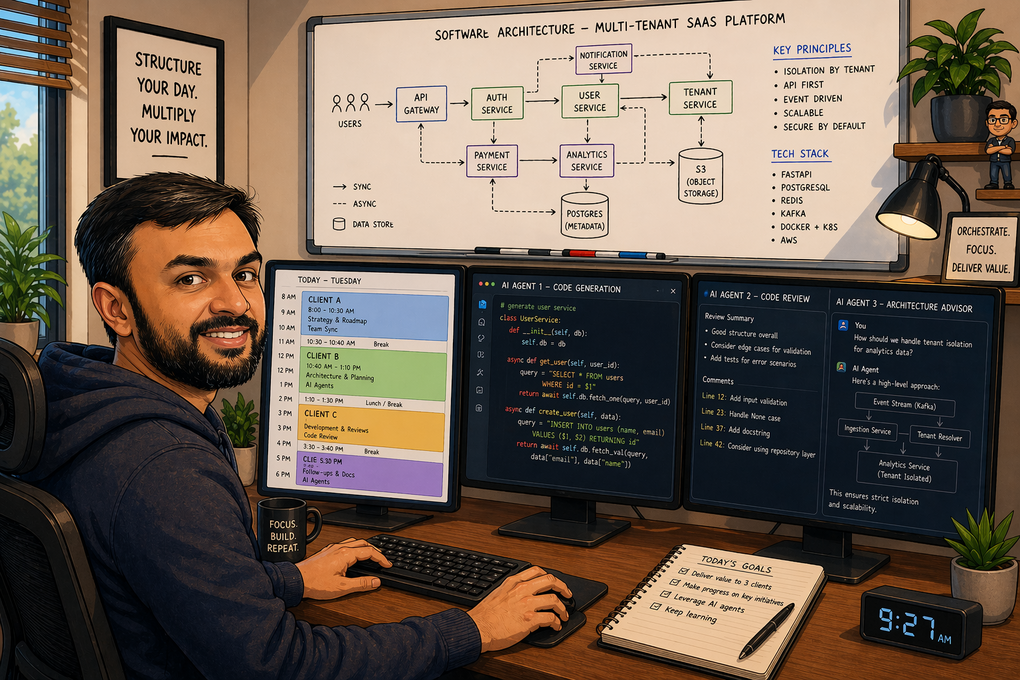
Those are not the same. The problem isn’t switching itself. It’s uncontrolled switching. And this is where there’s a useful takeaway. To get to LADD, you first need LSAS. Instead of trying to eliminate context switching, structure it the way schools already do. Divide your day into blocks. Give each task a defined window. Allow for a small gap between them, even if it’s just a few minutes to reset.
You were already trained to do this in school.
And if you work on all your projects every day, instead of every other day, your ramp time to switch between them gets lower. Then it keeps getting lower as you get used to that rhythm.
You’re already halfway to LADD. Not as a flaw, but as a skill you can intentionally build.