
In Part 1 (Learned ADD) and Part 2 (Learned Short Attention Span) of this series, I covered how our schools inherently teach us to task switch. So using those lessons, we’ve split our day into project-based chunks. We’ve started getting better at intentionally switching between tasks. We’ve accepted that switching itself is not automatically bad.
But now we run into the real problem. Distractions. The real problematic context switching. Emails. Slack messages. Texts. The tiny red notification bubble that somehow feels impossible to ignore. This is where most harmful context switching actually comes from. Not from intentionally moving between tasks, but from being interrupted in the middle of them.
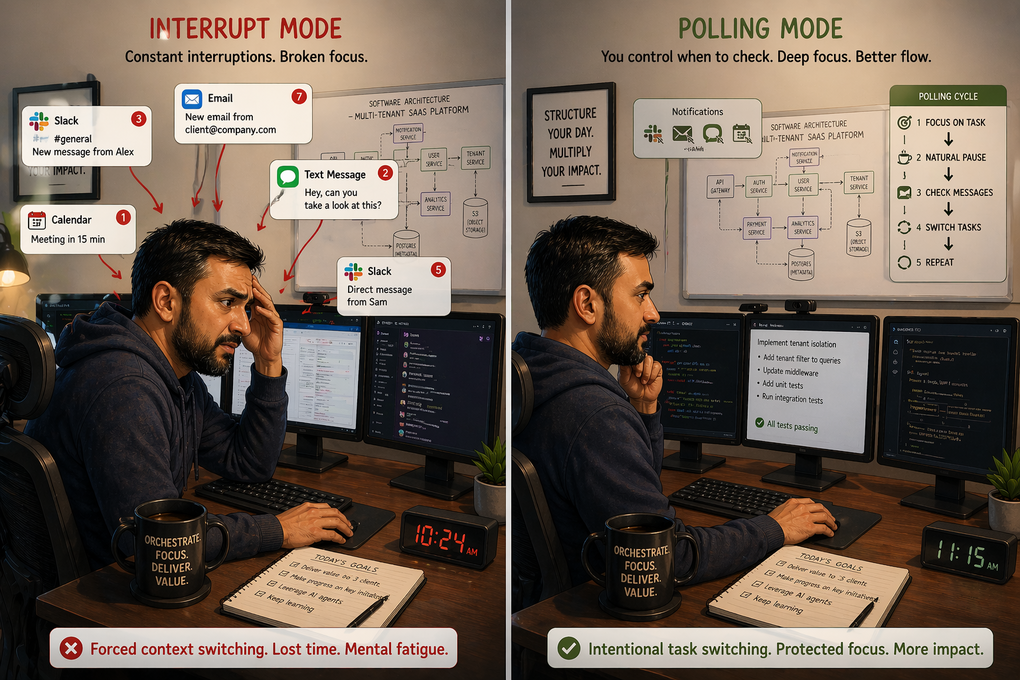
In software engineering, there are generally two ways to know if something happened: polling and interrupts. An interrupt means something external forces the system to stop what it’s doing and handle a new event immediately. Polling means the system decides when to check for updates.
Most of us work in interrupt mode all day long. A Slack message comes in and we instantly look. An email notification pops up and we click it. A text arrives and we respond. Each interruption feels tiny, but every single one forces your brain to drop context and reload it later. That reload cost is the real problem even if it is only 10 minutes.
The important realization is this: almost nobody actually expects an immediate response. A few minutes is fine. Ten minutes is fine. Even an hour is usually fine. But our tools are designed to make everything feel urgent.
So instead of fighting task switching entirely, what if we changed how switching happens? What if we moved from interrupts to polling?
Turn off notifications. No popups. No sounds. No red dots pulling your attention away every few minutes. Then, when you reach a natural stopping point or when you’re already switching tasks, check everything intentionally. Slack. Email. Texts. Respond if needed, then move on. You’re still responsive. You’re just no longer reactive.
This fits naturally into the structure we already talked about in Part 2. You already divide your day into blocks. Communication simply becomes another intentional step in the cycle instead of a constant interruption layered on top of it.
The workflow changes from:
Work → interrupted → recover → interrupted again
to:
Work → finish a unit → check messages → switch → continue
That one change removes an enormous amount of forced context switching.
It takes some getting used to because we’ve been conditioned to respond immediately to everything. But try it for a single day. You’ll notice something surprising. Task switching itself is not the thing exhausting you. Forced context switching from interruptions is.